※本ページはプロモーションが含まれます
Disclosure: This post contains affiliate links. If you buy through them, we may earn a commission at no additional cost to you. Learn more.
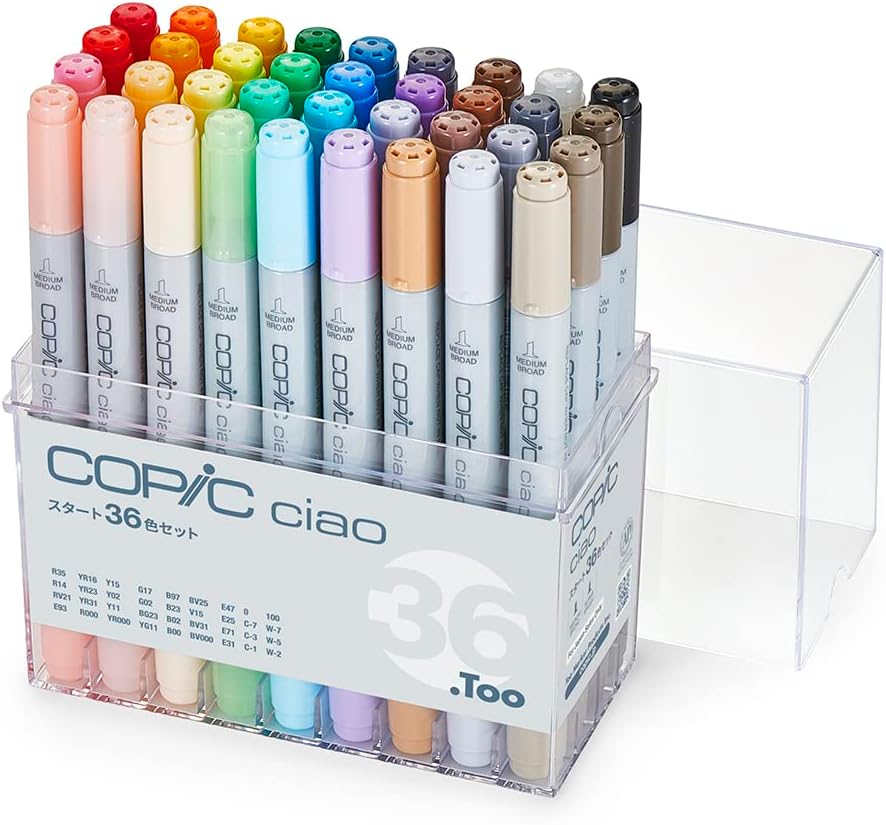
Copic is the marker system almost every manga, character and concept artist eventually ends up using, and it confuses newcomers for one specific reason: it isn’t a product, it’s a whole apparatus of four marker lines, a lettered color-code language, a separate range of line-art pens, refill inks and replaceable nibs. The short version if you just want to start: buy the Copic Start 36-color set at 13,256 JPY (about $83), which works out to roughly $2.30 a marker against $9–11 for singles, add one Multiliner in 0.1mm black for about $8, and don’t buy anything else until you’ve worn a nib out. Everything below is the rest of the system, and where it’s worth your money.
Prices are the mall’s listed JPY converted at roughly ¥159/USD as of August 21, 2026, so treat the dollar figures as ballpark. This is a companion to our Japanese fountain pen buying guide — different tool, completely different reasons to care.
What a Copic actually is
Every marker in the core range is a twin-tip pen filled with alcohol dye ink. Two consequences follow from “alcohol,” and they’re the whole reason the brand exists.
First, the ink doesn’t dissolve toner. The listings say this outright on both the Classic and Sketch lines: you can print or photocopy your line art, color straight over it, and the black lines won’t smear. That single property is why Copic became the manga studio standard.
Second, alcohol ink blends on the paper surface rather than soaking into the fibers, so two overlapping colors merge into a smooth gradient instead of pilling and buckling the sheet the way water-based markers do. The Classic listings add that the ink “does not wrinkle even when drawing on thin paper,” which is the same fact from the other direction.
The markers are also designed to be refilled with Various Ink and re-nibbed rather than thrown away — the entry-model listing spells that out explicitly. Worth flagging up front: this particular mall does not currently stock Various Ink refills or replacement nibs, only markers, so if you’re buying here, plan on sourcing consumables elsewhere later. It doesn’t change the value of the markers, but the “buy once, refill forever” pitch only works if you can actually get the refills.
How to read a Copic color code
This is the part that looks arbitrary and isn’t. Every color is a letter (or letter pair) plus a number, and once you can read it you can predict what a color looks like and which colors will blend with it, without a swatch chart.
The letters are hue families. From products currently in stock you can see most of them: B blue, BG blue green, BV blue violet, V violet, RV red violet, R red, YR yellow red (oranges), Y yellow, YG yellow green, E earth (the browns and skin tones), and C cool gray. The system also runs neutral, warm and toner gray families and a fluorescent set.
The first number is the blending group — roughly, how saturated and how “the same kind of color” it is. The second number is brightness, where a low digit means pale and a high digit means deep. You can watch this work across three Classic markers on the shelf right now: E40 Brick White is a barely-there pale earth, E44 Clay is a mid-tone, and E49 Dark Bark is nearly the darkest brown in the family — same letters, same first digit, three rungs of a single ladder. Likewise C4 and C5 Cool Gray are adjacent steps of the same gray.
Two edge cases: extra zeros mean extra pale — the Booster Box includes YR0000, which is the faintest tint of orange the range goes to — and pure numbers with no letter are the blacks and the blender. Classic 110 Special Black is the dense black; 0 is the Colorless Blender, which carries no pigment and is used to push color around and soften edges.
The practical payoff: markers sharing a letter and first digit blend seamlessly. The Booster Box ships E30 and E34 together for exactly this reason — they’re two stops on one ladder, so you can lay the darker one down and feather it into the lighter one with no visible seam. Buying three markers from one blending group teaches you more than buying twelve scattered colors.
The four marker lines, compared
Copic Sketch — the one most people mean

Sketch is the flagship: an oval barrel with a Super Brush nib on one end — a genuine flexible brush tip, not a felt wedge — and a medium broad on the other. The E74 Cocoa Brown single is 1,553 JPY (about $10) and its listing describes the range as “over 300 colors”; the 24-color set listing puts the current Sketch palette at 358. The brush nib is what makes Sketch worth the premium — it does hair, fabric folds and soft shadow edges that a chisel tip physically can’t.
The caveat: at about $10 each, a functional palette is expensive arithmetic. Thirty markers is $300, and thirty is not a lot once you’re matching skin tones and shadows. Brush nibs also splay and soften with heavy use, and since replacement nibs aren’t stocked here, a frayed brush means either living with it or sourcing nibs from another supplier.
Copic Classic — the original, and the odd one out on price

Classic is the line the brand started with: a square 14cm body that won a Good Design Award and, more usefully, does not roll off a sloped desk. Instead of a brush it carries two polyester tips, broad and fine. Stock here includes E44 Clay, E40 Brick White, E49 Dark Bark, RV13 Tender Pink, R29 Lipstick Red, Y06 Yellow, C4 and C5 Cool Gray, and 110 Special Black, at 1,734–1,753 JPY (about $11) each.
Classic suits flat graphic fills, architectural and product rendering, and anyone who finds a brush nib too loose to control.
The caveat: note that price. Classic singles here cost slightly more than the Sketch single ($11 vs $10) while giving you a less versatile nib — the square body and the fine tip are the only things you’re buying. Unless you specifically want the fine tip or hate rolling pens, Sketch is the better default.
The entry model — same ink, smaller pen

The listing for Copic 100 in Black at 1,364 JPY (about $9) describes it as “an affordable entry model for first-time Copic users,” with the same drawing feel and color quality as Sketch, a range of 180 colors including the Colorless Blender, refillable with Various Ink, and a replaceable tip — specifically, it takes the Copic Sketch replacement nib. That’s the Ciao line, which other listings here name directly: the Illustration Set Mini is described as containing “Copic Ciao: R20/Y11/BG72/E11/E50,” and the marker wallet lists separate capacities for Sketch, Ciao and Classic.
The caveat: it’s a smaller barrel holding less ink, so it empties sooner, and 180 colors versus 358 means the fine-grained tonal steps you eventually want for skin and fabric are the ones missing. It’s the right first marker and the wrong tenth one. Also, buying a single Black as your entry point is a strange move — black is the color you’ll use least in a blend-based medium.
Copic Acla Light — related by name only

The Acla Light 6-color set at 3,075 JPY (about $19) shares the brand and nothing else. It’s a water-based opaque pigment paint marker — lilac, coral pink, custard beige, cream yellow, apple green, turquoise blue — that goes down on paper, stone, wood, plastic, glass, ceramic, cloth and leather and becomes water-resistant once dry.
The caveat: do not buy this expecting Copic blending. Opaque pigment sits on top of the surface; it will not feather into a gradient, and it will not interact with your alcohol markers. It’s a craft and lettering marker that happens to say Copic on it. Useful, just not part of the same system.
Multiliner — the line-art half of the system

Ordinary fineliners bleed and smear when alcohol marker crosses them. Multiliner exists to not do that: water-resistant pigment ink, engineered specifically so Copic ink won’t lift it. The range runs nine line widths; stocked singles are 0.03mm, 0.05mm, 0.1mm, 0.3mm and 0.5mm in black at 1,293 JPY (about $8) each, plus a Warm Gray 0.03mm at 1,296 JPY for softer main lines that don’t fight the color.
Sets cut the per-pen cost: a 4-piece black set is 2,135 JPY (about $13), the A-2 set 2,745 JPY (about $17), the B-2 set 3,181 JPY (about $20), and a 4-piece pink set 2,021 JPY (about $13).
The one worth saving for is the Multiliner SP Set MLSP10A at 6,417 JPY (about $40): aluminum-bodied pens you refill and re-nib instead of discarding, in all ten widths — 0.03, 0.05, 0.1, 0.2, 0.25, 0.3, 0.35, 0.5, 0.7mm and a brush tip. We also picked this set in our roundup of Japanese pens for bullet journaling and planners, where the fine widths earn their keep on spread decoration.
The caveat: the standard Multiliners are disposable, so at $8 a pen the running cost adds up if you draw a lot — which is the argument for the SP. But the SP’s own consumables (cartridges and nibs) aren’t stocked here either, so its refillability is theoretical until you find a supplier. And the 0.03mm tip in either version is genuinely fragile; press hard and you’ll bend it.
Which set is the best entry point?

Sets are where Copic stops being punishingly expensive. Four are in stock:
- Copic Start 36-color Set — 13,256 JPY (about $83), roughly $2.30 a marker. The best value here by a wide margin and the default recommendation. Its listing gives only the set name and count, so you’re trusting Copic’s color curation sight-unseen — which, for a beginner set assembled by the manufacturer, is a reasonable trust.
- Sketch Comic Illustration 24 Color Set — 11,902 JPY (about $75), about $3.10 a marker, drawn from the 358-color Sketch palette with a deliberate bias toward the pale colors used in comic illustration, chosen to mix and gradate cleanly. The listing says plainly that it’s recommended for people who already own singles.
- Booster Box — 12,276 JPY (about $77) for 20 named Sketch colors (BV01, V22, RV11, R01, R12, R24, R83, YR0000, YR14, Y13, Y32, YG45, BG11, B01, B14, B21, E27, E30, E34 and the Colorless Blender), two Multiliners (0.1 Black and 0.05 Sepia), a Copic Lesson Book, a work notebook with six lesson pages, four coloring pages and ten blanks, a writing pad and a drawer box, at 18.2 × 23.5 × 4.9cm.
- Illustration Set Mini (Pop) — 4,531 JPY (about $29) for five Ciao markers (R20, Y11, BG72, E11, E50), a Sepia 0.3 Multiliner and three coloring sheets. The cheapest real taste of the system.
The caveats: the 24-color Sketch set is explicitly a supplement, not a foundation — a palette weighted toward pale tones will leave you with no darks to shade with, so don’t make it your first purchase despite the tempting name. The Booster Box is the better teaching purchase but poorer value per marker than the Start set, and since it’s the Japanese domestic edition, expect the lesson book and notebook to be in Japanese; the coloring pages carry over fine regardless. And the Mini set at $29 for five markers is $5.80 each — cheap in absolute terms, poor value per pen.
Paper, storage, and the bleed problem
Alcohol ink goes through ordinary paper. This is not a defect, it’s physics — the ink is designed to flood fibers so colors merge. On copy paper you’ll get a mirror image on the next sheet, so either put a scrap underneath or use paper made for it. Copic’s own Paper Selection colored paper at 1,365 JPY (about $9) is a smooth Western-paper stock that barely frays when you erase on it. For heavier mixed-media work, the sheets in our Japanese watercolor paper guide will hold marker without ghosting through, at the cost of a toothier surface.
For storage, the Pochette Wallet in navy is 4,859 JPY (about $31) and holds roughly 40 Sketch, 50 Ciao, 30 Classic or 33 refill inks in a H160 × ⌀120mm cylinder; the flat Wallet for 24 Markers is 4,443 JPY (about $28) at 170 × 280 × 40mm.
The caveat: $28–31 is a lot for a marker case, and it’s money not spent on markers. A cheap zip pouch does the same job until your collection outgrows it.
So what should your first Copic purchase actually be?
If you’re reasonably sure you’ll stick with it: the Start 36-color set at about $83, plus a 0.1mm Multiliner at about $8. That’s roughly $91 for a genuinely workable kit, and the per-marker cost is a quarter of what singles run.
If you want to test the water first: the Illustration Set Mini at about $29 gets you five Ciao markers, a Multiliner and something to color, and if it doesn’t click you’re out less than the price of three singles.
If you already own markers and know what you’re missing: buy singles by blending group, not by color. Three markers sharing a letter and first digit — the way E40, E44 and E49 sit on one ladder — will improve your work more than three unrelated colors, because gradation is the whole point of the medium.
What not to start with: a Classic single (costs more than Sketch for a less capable nib), the 24-color comic set (pale-biased, explicitly a second purchase), or Acla Light (different medium entirely).
Comparison table
| Product | Line | Nibs / widths | Approx. price | Best for |
|---|---|---|---|---|
| Copic Start 36-color Set | Set | Twin-tip × 36 | ~$83 | The best-value real starting kit |
| Sketch E74 Cocoa Brown | Sketch | Super Brush + medium broad | ~$10 | Filling gaps in a palette |
| Copic 100 Black (entry model) | Ciao / entry | Same feel as Sketch, 180 colors | ~$9 | Trying one marker cheaply |
| Classic E44 Clay | Classic | Polyester broad + fine, square body | ~$11 | Flat fills, technical rendering |
| Sketch Comic Illustration 24 Set | Set | Twin-tip × 24, pale-biased | ~$75 | A second set for skin and highlights |
| Booster Box | Set + lessons | 20 Sketch + 2 Multiliner + book | ~$77 | Learning the medium, not just owning it |
| Illustration Set Mini (Pop) | Set | 5 Ciao + Multiliner + sheets | ~$29 | Testing before committing |
| Multiliner 0.1mm Black | Multiliner | 0.1mm, pigment | ~$8 | The one line pen everyone needs |
| Multiliner SP Set MLSP10A | Multiliner SP | 10 widths, 0.03–0.7mm + brush | ~$40 | Refillable line work, long term |
| Acla Light 6-color Set | Acla Light | Water-based opaque pigment | ~$19 | Lettering on non-paper surfaces |
FAQ
What’s the actual difference between Copic Sketch, Ciao and Classic?
Sketch is the flagship: oval barrel, Super Brush nib plus a medium broad, and the widest palette at 358 colors. Ciao — sold here as the “entry model” — has the same ink and, per its listing, the same drawing feel and color quality, but a smaller, cheaper barrel holding less ink and a narrower 180-color range; it takes Sketch replacement nibs. Classic is the original square-bodied marker with two polyester tips, broad and fine, and no brush. For most people Sketch is the right default, Ciao is the right way to try one, and Classic only makes sense if you specifically want the fine tip.
What do the letters and numbers in a Copic code actually mean?
The letters are the hue family — B blue, BG blue green, BV blue violet, V violet, RV red violet, R red, YR orange, Y yellow, YG yellow green, E earth and browns, C cool gray, plus the other gray and fluorescent families. The first number is the blending group, and the second is brightness, with low meaning pale and high meaning deep. E40 is a very pale earth, E44 a mid-tone and E49 nearly the darkest in that family. Extra zeros mean extra pale, as in YR0000, and pure numbers with no letter are the blacks and the Colorless Blender, which is coded 0.
Do Copic markers bleed through paper, and what should I use?
Yes, on ordinary paper they will, because alcohol ink is designed to flood the fibers so colors merge cleanly. Either put a scrap sheet underneath or use paper made for markers, such as Copic’s own Paper Selection stock. Heavier art papers hold the ink without ghosting through, though the rougher surface changes how the brush nib feels and wears it faster.
Can I refill Copic markers, and are refills available?
The markers are built to be refilled with Various Ink and re-nibbed rather than replaced, and the entry-model listing confirms both the refill compatibility and that its tip is replaceable using the Sketch replacement nib. However, this mall’s Copic stock is currently markers, sets, cases and paper only — no Various Ink bottles and no replacement nibs — so if you buy here, plan on sourcing consumables from another supplier when the time comes.
Is a 36-color set better value than buying individual markers?
Substantially, yes. The Start 36-color set works out to roughly $2.30 a marker against $9 to $11 for singles, so even if a third of the colors sit unused you’re still ahead. The trade-off is that you don’t choose the colors. Buy the set first for coverage, then buy singles deliberately to fill in the blending ladders you find yourself needing — three markers from one blending group will do more for your work than three unrelated ones.
Takeaway
Copic’s reputation for being expensive is earned at the single-marker level and almost entirely undone by the sets: $83 for 36 markers is a fair price for a professional medium, while $10 a pen for the same markers individually is not. Start with the Start set, add one Multiliner, learn to read the codes so you can buy the next three markers as a blending ladder rather than a color wish list, and accept that the refill economy — the part that makes Copics genuinely long-lived — currently means looking beyond this catalog for ink and nibs. If you’d rather work in paint than marker, our comparison of Japanese watercolor paints — tubes, pans and gouache covers the other big Japanese color system side by side.
コメント